
There is a version of education that happens between the hours of three and six in the afternoon that most people never fully appreciate. It does not involve standardized tests or curriculum mandates. It does not come with letter grades or report cards. But it produces something that formal schooling, for all its structure and intention, often struggles to deliver on its own: young people who know how to think on their feet, work with others, bounce back from failure, and navigate the messy, unpredictable terrain of actual life. After-school programs have spent decades quietly doing this work, and the evidence behind their impact has grown from promising to genuinely compelling. The gap between what classrooms teach and what the real world demands is real, wide, and consequential. Understanding how after-school programs bridge that gap is not just an academic question. It is one of the most important conversations we can have about what it means to truly prepare young people for the lives ahead of them.
The Gap That Classrooms Alone Cannot Close
Schools are designed to transmit knowledge. They are built around curricula, standards, and assessments that measure what students know and can reproduce under controlled conditions. This is valuable and necessary. But knowledge alone does not produce capable, confident, adaptable young adults. The world beyond school requires a fundamentally different set of capacities, things like the ability to collaborate under pressure, to communicate across differences, to manage time and competing priorities, to recover from setbacks without losing momentum, and to apply abstract knowledge to concrete, often ambiguous real-world problems. These are not skills that emerge automatically from academic instruction, no matter how excellent that instruction is.
Why Traditional School Structures Leave Certain Skills Behind
The architecture of traditional schooling works against certain kinds of learning almost by design. The pressure to cover mandated content within fixed timeframes leaves little room for the kind of open-ended exploration, extended project work, and iterative experimentation through which real-world skills are actually built. Students spend the majority of their school day sitting, listening, reading, and writing in individual, evaluative contexts where the goal is to produce correct answers rather than to navigate genuine uncertainty. They receive constant feedback in the form of grades that rank and sort their performance but rarely develop the habit of self-assessment or the capacity to learn productively from failure. The competitive, grade-focused culture of many schools also inadvertently discourages the risk-taking and creative thinking that professional and civic life consistently demands. None of this is an indictment of teachers or schools. It is a structural reality that after-school programs are uniquely positioned to address.
The Hours Between School and Dinner Matter More Than Most Parents Realize
Research from the Afterschool Alliance consistently shows that the hours between three and six in the afternoon represent a peak period for juvenile risk behaviors including substance use, delinquency, and unsafe sexual activity. They also represent the window during which low-income students are most likely to fall behind their more advantaged peers who spend these hours in enrichment activities, tutoring, and skill-building experiences. The opportunity cost of this time is enormous in both directions. When it is filled with nothing, it creates risk and widens inequality. When it is filled with high-quality after-school programming, it becomes one of the most powerful interventions available for supporting youth development across academic, social, emotional, and practical dimensions simultaneously. The three to six window is not dead time waiting to be managed. It is prime developmental real estate waiting to be invested in.
What Makes After-School Programs Uniquely Effective
After-school programs operate in a fundamentally different context from schools, and that difference is not a limitation. It is a feature. The absence of formal academic pressure, the voluntary nature of participation, the more flexible structure, and the emphasis on doing rather than knowing all create conditions for a different and complementary kind of learning that fills exactly the gaps formal schooling leaves open.
The Power of Low-Stakes Learning Environments
When the consequence of failure is a grade that follows a student on their transcript, the psychological cost of trying something difficult and getting it wrong is high. Many students, particularly those who have been conditioned by competitive academic environments, respond to this by playing it safe, sticking to what they already know, and avoiding challenges that carry real risk of visible failure. After-school programs, by contrast, create low-stakes environments where trying, failing, and trying again is not only acceptable but actively encouraged and modeled. A student who builds a robot that does not work in a robotics club learns something in the debugging process that a perfect score on a science test cannot teach. A student who delivers a poem at an open mic night to an audience that does not fully connect with it develops a resilience and a willingness to be seen that no classroom assignment produces. The low-stakes nature of after-school learning is precisely what allows students to take the kinds of risks through which deep learning actually happens.
Mentorship Relationships That School Structures Rarely Allow
One of the most consistently documented benefits of high-quality after-school programs is the relationship quality between young people and the adults who lead them. Teachers in school settings manage classrooms of twenty-five to thirty students, navigate mandatory curricula, and operate under the weight of accountability systems that leave limited time for the kind of sustained, individualized relationship-building that changes a young person’s sense of who they are and what they are capable of. After-school program leaders typically work with smaller groups, in less hierarchical settings, over extended periods of time, in contexts where the shared activity creates natural opportunities for genuine connection. These mentorship relationships are not peripheral to the learning that happens in after-school programs. They are central to it. Research on youth mentorship consistently shows that a trusting relationship with a caring non-parental adult is one of the most powerful predictors of positive youth outcomes across academic, social, and long-term career dimensions.
Core Real-World Skills That After-School Programs Actively Develop
The specific skills that after-school programs build vary by program type, design quality, and participant age. But across the research literature and practitioner experience, several core competencies emerge consistently as the distinguishing outcomes of effective after-school participation.
Collaboration, Communication, and Conflict Resolution
The ability to work effectively with other people is among the most universally cited skills that employers, higher education institutions, and community leaders identify as deficient in young adults entering adulthood. School teaches students to perform academically as individuals. After-school programs teach them to function as members of teams, communities, and creative partnerships. A student participating in a theater program must coordinate with peers on every element of a production, negotiate creative differences, support others through performance anxiety, and deliver a shared product to a real audience. A student in a community service program must communicate with community members across generational and cultural differences, manage competing priorities within a volunteer team, and navigate the kind of real-world complexity that no classroom simulation fully replicates. These experiences do not just build soft skills in an abstract sense. They build specific, practiced competencies that young people carry into every subsequent context of their lives.
Problem-Solving Through Project-Based and Experiential Learning
After-school programs are particularly well-suited to project-based learning, an instructional approach that requires students to apply knowledge and skills to solve real, complex, open-ended problems over an extended period. Unlike the tightly bounded problem sets of academic instruction, project-based learning in after-school contexts typically involves genuine ambiguity, multiple viable approaches, iterative refinement, and a real audience or end user for the final product. A group of middle school students designing and pitching a community garden for their neighborhood is not practicing problem-solving in the abstract. They are doing it, with all the messiness, creativity, negotiation, and satisfaction that real problem-solving involves. This kind of learning produces what education researchers call transfer, the ability to apply skills and knowledge flexibly across contexts, which is precisely what distinguishes students who perform well on tests from young adults who perform well in life.
Leadership, Initiative, and Self-Direction
After-school programs consistently provide young people with opportunities to take on leadership roles that school structures rarely accommodate outside of formal student government positions. In a youth program, a teenager might organize an event, lead a peer workshop, manage a budget, train new members, or represent their program at a community meeting. Each of these experiences requires a quality of initiative and self-direction that is qualitatively different from completing an assigned task in a classroom. Young people who have these experiences develop what psychologists call an internal locus of control, the belief that their actions have genuine impact on outcomes, which is one of the strongest psychological predictors of long-term academic persistence, career success, and civic engagement. Leadership in after-school contexts is not ceremonial. It is real, consequential, and developmentally transformative.
The Role of Arts, Sports, and STEM Programs in Skill Development
Different types of after-school programs build real-world skills through different pathways, and understanding these distinct mechanisms helps parents, educators, and program designers make more intentional choices about program design and participation.
Arts Programs and the Skills They Quietly Build
Arts-based after-school programs, including theater, visual arts, music, creative writing, and dance, are sometimes perceived as enrichment extras rather than serious skill-building contexts. This perception fundamentally misunderstands what arts participation actually develops. Research from the President’s Committee on the Arts and the Humanities has documented that sustained arts participation is associated with higher academic achievement, stronger creative thinking, greater persistence, and significantly better social-emotional outcomes compared to non-participants. The mechanisms are specific and concrete. Theater builds public speaking confidence, empathy through character embodiment, and collaborative discipline through ensemble work. Music develops sustained attention, pattern recognition, emotional regulation, and the understanding that excellence requires consistent practice over time. Visual arts build spatial reasoning, iterative thinking, and the tolerance for ambiguity that creative and professional problem-solving demands. These are not peripheral skills. They are foundational ones.
STEM and Tech Programs That Prepare Youth for the Modern Economy
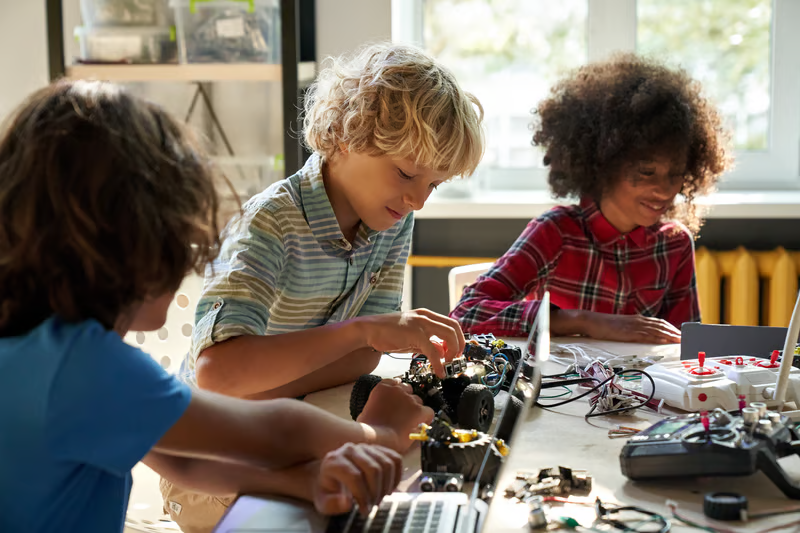
STEM-focused after-school programs, including coding clubs, robotics teams, engineering challenges, and science exploration programs, have proliferated rapidly over the past decade in response to growing recognition that technological literacy is becoming a baseline competency for participation in the modern economy. These programs are valuable not primarily because they produce future software engineers, though some participants do go on to those careers, but because of the habits of mind they cultivate in all participants. Coding teaches logical decomposition, systematic debugging, and the understanding that complex problems can be solved by breaking them into manageable parts. Robotics teaches iterative design, the management of failure as information rather than defeat, and the collaboration required to build something that works in the physical world. Engineering challenges teach constraint-based thinking, creative resource use, and the satisfaction of making something real. These cognitive frameworks transfer powerfully to contexts far beyond technology.
How Quality After-School Programs Complement and Reinforce Academic Learning
One of the most persistent misconceptions about after-school programs is that they exist in opposition to academic learning, as a break from the serious business of school. In reality, well-designed after-school programs actively reinforce and accelerate academic learning by providing the applied context and motivational fuel that classroom instruction requires to fully take root.
Homework Support That Goes Beyond Getting Answers
Many after-school programs include homework help components, but the most effective ones go well beyond helping students complete assignments. They use homework time to build genuine academic habits: the ability to organize multi-step tasks, the tolerance for sustained cognitive effort, the habit of checking one’s own work, and the skill of asking productive questions when stuck. These metacognitive skills, skills about how to approach learning itself, are among the most powerful determinants of long-term academic success, and they are difficult to teach within the time constraints of a regular school day. When a caring program staff member sits with a struggling student not to provide the answer but to model the thinking process of working through difficulty, the lesson being taught is far more durable than the specific homework problem being solved.
Connecting Academic Content to Real-World Meaning
One of the most common questions students ask in school is also one of the most legitimate: when am I ever going to use this? After-school programs answer that question experientially rather than rhetorically. A student who struggles to see the relevance of fractions in math class discovers their concrete necessity when measuring ingredients for a cooking program recipe. A student who finds grammar instruction tedious discovers its communicative power when crafting a speech they will deliver to a real audience. A student who has never connected with history textbooks finds themselves riveted by an oral history project that has them interviewing community elders about lived experiences of historical events. These applied connections do not just make learning more engaging in the moment. They fundamentally change a student’s relationship with academic content by demonstrating that it exists in the world, not just on a page.
Equity and Access: Why After-School Programs Matter Most for Underserved Youth
The benefits of after-school participation are documented across demographic groups, but they are not equally distributed. Young people from low-income families, communities of color, and under-resourced neighborhoods have historically had the least access to the kinds of enrichment and skill-building experiences that more affluent families purchase privately through sports leagues, arts classes, tutoring, and travel. This inequality in access to experience is a significant driver of the opportunity gap that shapes life outcomes in America and globally. High-quality, accessible after-school programs represent one of the most powerful and cost-effective policy tools available for narrowing that gap.
The Documented Impact on Students From Low-Income Communities
Studies examining the impact of after-school program participation on students from low-income families consistently document outcomes that go well beyond what most academic interventions produce. The RAND Corporation’s longitudinal research on after-school programs found that students from disadvantaged backgrounds who participated regularly in quality programs showed significant improvements in academic achievement, school attendance, social skills, and reduced engagement in risk behaviors compared to similar students without program access. Crucially, the effects were strongest for students with the highest levels of program participation, suggesting that consistent engagement rather than occasional attendance is what produces transformative outcomes. This dose-response relationship has important implications for program design and family engagement, reinforcing the value of building programs that young people genuinely want to attend regularly rather than programs that simply exist as an option.
Expert Advice: What Youth Development Researchers and Practitioners Say
Dr. Gil Noam, founder of the PEAR Institute at Harvard Medical School and McLean Hospital and one of the most influential voices in after-school research and practice, has spent decades documenting what distinguishes after-school programs that produce genuine youth development outcomes from those that simply provide supervision. His core finding is that program quality is the decisive variable, and quality is determined primarily by the strength of relationships between staff and young people, the developmental appropriateness of program activities, and the intentionality with which programs design for specific skill-building outcomes rather than just activity provision. He argues that the field has moved past the question of whether after-school programs matter, because the evidence on that is now clear and consistent, to the more urgent question of what program quality elements matter most and how to scale them equitably. His PEAR model, which stands for Partnerships in Education and Resilience, provides a research-validated framework for assessing and improving program quality across diverse settings.
Dr. Jacquelynne Eccles, a distinguished developmental psychologist whose decades of research on motivation, identity, and youth participation have shaped the entire field of youth development, emphasizes that the most transformative after-school programs are those that succeed in helping young people develop a positive identity connection to the skills and activities the program offers. When a young person comes to see themselves as a scientist, a leader, an artist, or a community changemaker through their after-school experience, something fundamentally different has happened compared to skill acquisition alone. They have updated their sense of who they are and what they are capable of, and that identity shift has motivational implications that extend far beyond the program itself. Her research on identity-based motivation suggests that this mechanism, connecting skill-building to self-concept, is the most powerful pathway through which after-school programs produce lasting impacts on young people’s trajectories.
Final Thought
The gap between what classrooms teach and what real life demands is not a failure of schools. It is a reflection of the genuine complexity of what it means to prepare a young person for a world that requires not just knowledge but wisdom, not just competence but character, not just the ability to answer questions but the courage to ask new ones. After-school programs have spent decades filling that gap, often quietly, often without the recognition or resources their impact deserves. Every young person who learns to lead a team, deliver a speech, debug a robot, resolve a conflict, or discover that they are capable of more than they thought they were in an after-school setting carries that knowledge into every room they enter for the rest of their lives. That is not a small thing. That is the whole thing. And the communities, families, and policymakers who understand that and invest accordingly are not just supporting programs. They are shaping the kind of future that all of us will eventually live in together.